
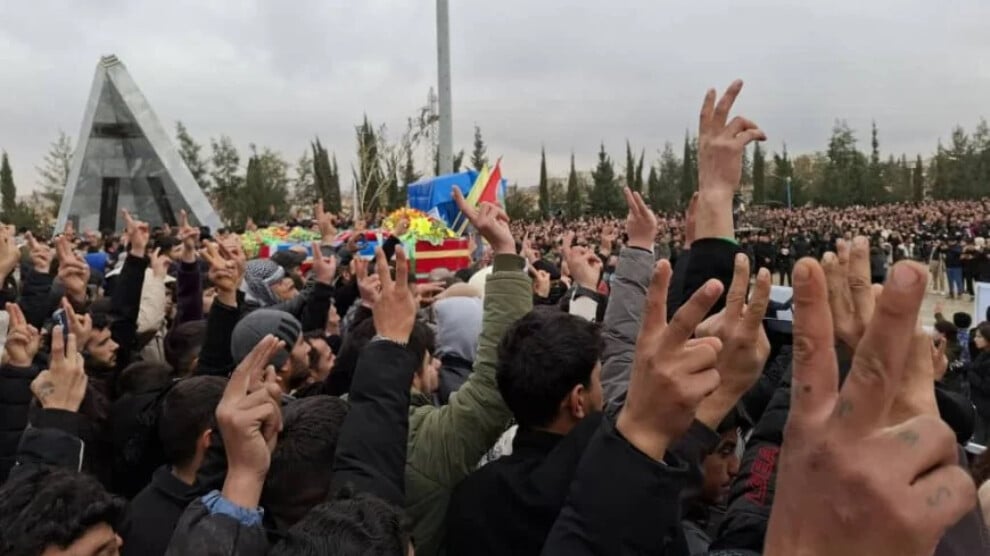
The Editorial Committee of Ronahî has prepared a series of several parts analyzing the current developments in the Middle East and in Kurdistan. In light of the attacks on the Democratic Autonomous Administration of North and East Syria (DAANES) and the concrete threat of war, we want to contribute to a better understanding of the current situation in North and East Syria. Furthermore, we want to emphasize, which role the ideas of Abdullah Öcalan, thinker, philosopher and representative of the Kurdish Freedom Movement, and his vision for a democratic Middle East play in times of massacre and bloodshed. In the first part we focus on US strategy for the Middle East and Öcalans proposal of a “Democratic Commune of the Middle East”.
There are some days whose historical significance we realize on the very same day. Such was the morning of January 3. In a few years, we will look back on these times. And no matter how much times may have changed, we will ask ourselves: “What did you do when you heard that the US had invaded Venezuela?” And we will shake our heads and hopefully add with a smile: “Those were chaotic times…”
Mass psychology and cognitive warfare long since became part of our everyday lives. So it’s no wonder that our first instinct when confronted with humanitarian crises is helplessness. This is not natural, but something we have been taught.
But when we begin to realize that the current state of our world is not a sealed fate, but rather a changeable, even very fragile dynamic, we can joyfully and energetically set about searching for alternative and better systems. Because ideas that have the power to transform the Middle East into a democratic region do exist. This text aims to contribute to the introduction of these ideas.
The current pace of global political developments and military conflicts has reached an almost unbearable speed. The US attack on Venezuela is on everyone’s lips. But how can we classify it within the overall US strategy? And what do the attacks by the Syrian transitional government of Hay’at Tahrir al-Sham (HTS) on the areas of the Democratic Autonomous Administration of North and East Syria (DAANES) have to do with the new US “National Security Strategy”? In the first part, we will try to explain some aspects of the “new” US “National Security Strategy” before turning our attention to the Middle East and the current situation in Syria in the second part. We will conclude with an outlook on the idea of Democratic Modernity for the Middle East.
The Monroe-Doctrine and US-Darwinism
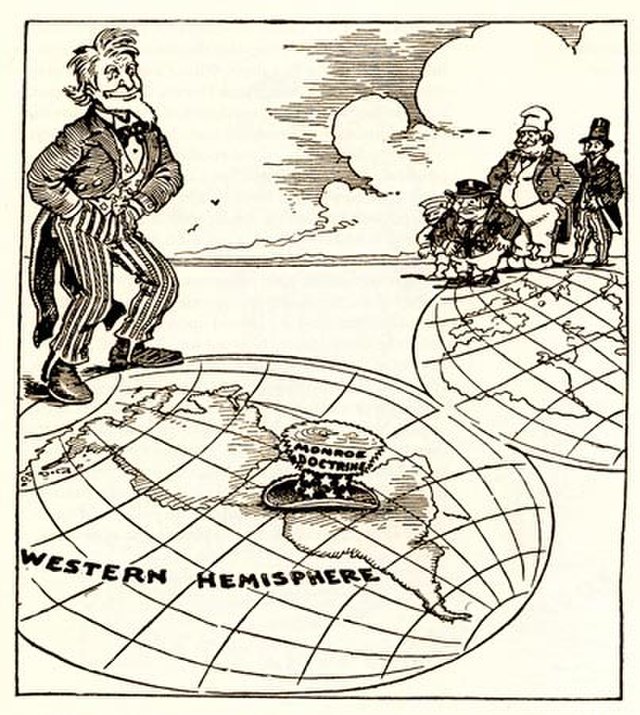
For more than 200 years, the US has considered the entire American continent, from Canada to Tierra del Fuego, to be its property and wants to reduce any external influence. “America for Americans”: that is the formula underlying the famous Monroe Doctrine. But something has changed in this new year. Since World War II, the number of military conflicts has never been as high as it is today1. The world is at war. It is a war for resources, for power, for minds and hearts. Because the current world order has reached its limits.
Like a rabid dog aware of its impending demise, the US is now searching for sustenance in the hope of staying alive as long as possible. In the Western Hemisphere, especially in the border regions, the US wants to ensure that “good governance” prevails2. Millei in Argentina, Kast in Chile, and, most likely, the incoming government in Venezuela are probably examples of what Trump envisions as “good governments.”
The government in Washington repeatedly signaled that they want to invade Colombia next. International law seems to be no longer valid since a long time. With annual military spending of $997 billion, around 1.3 million soldiers, and industrial hegemony, the US still stands at the pinnacle of capitalist modernity3. The only law that applies is the “Survival of the fittest”.
US foreign policy strategy: “International Fascism First”
In connection with the Cold War and military invasions in the course of the “war on terror,” numerous scandals involving the US in covert and overt operations abroad have come to light. The new US “National Security Strategy” bluntly explains how the US intends to continue securing its position at the top of the power pyramid.
The document repeatedly emphasizes that a clear focus is important. It is said that this has been lacking until now. The focus of the new foreign policy of the US is clearly no longer on Europe. Latin America, Asia, the Middle East, and Africa have moved more clearly into the center of their strategy.
In Latin America, the US government appears to be attempting to bring “like-minded,” i.e., fascist governments to power. Interventions such as those in Venezuela are probably just the beginning. Governments that do not fall under the US definition of “good governments” will likely be overthrown by military force more frequently. This is especially true if their geopolitical location is central to trade routes and the transport of raw materials to the US, as is the case with Venezuela and Colombia.
In Europe, the US is seeking to undermine the EU. This is evident from an unpublished version of the “National Security Strategy” published by Defense One4.
The focus is on strengthening nationalist and right-wing governments, especially in Poland, Hungary, Austria, and Italy. In this way, the US aims to weaken the EU’s position as a united alliance, while maintaining bilateral relations with European states. The pressure to invest more in their own defense also has clearly self-serving purposes: increased investment in its own defense gives the US the opportunity to withdraw more strongly from the EU, because the EU can provide its own deterrent against the “threat from the East.” On the other hand, it ties up capital for a specific purpose. This capital can no longer be used by European states to further expand their own power ambitions, securing a stronger position for the US.
Abraham Accords vs. Democratic Commune of the Middle East
In the Middle East, the US and Israel have been working on a new strategy since 2020: the Abraham Accords are intended to “normalize” Israel’s relationship with Arab states. Normalization here means nothing more than establishing Israel as the dominant and guiding force. One obstacle to this is Iran and its “axis of resistance”5.
Iran threatens Israel’s supremacy. Iran is also fighting for mineral resources and the security of new trade routes, such as China’s Belt and Road Initiative, also known as the New Silk Road. It is the competing trade route project to the “Indian-Middle Eastern Corridor” (IMEC) initiated by the US. Investors in both projects are concerned about unsafe areas through which exports can only be made at risk.
Today, most of the militias of the “axis of resistance” are either severely weakened or have already been eliminated. Now, an attack on Iran and regime change à la HTS in Syria6 are likely imminent, after which further attention will turn to other unyielding actors. One such unyielding actor could be Turkey, if it continues to insist on its current course until then. In short, the strategy of the US and Israel for the Middle East is… .
a.) …to weaken Russian, Iranian, and Chinese influence in the Middle East
b.) …to bind the Arab states to Israel through the Abraham Accords, and
c.) …to secure the region’s natural resources and military control of trade routes that are in their interest.
Their Middle Eastern strategy is profit-driven. If it is profitable, they even genocide commit as part of this plan, as we are witnessing in Palestine. The US and Israel have a vision for the Middle East and the world. A vision of the rule of the few over all, a vision for which they will not shy away from massacres and murders in order to achieve it.
The Democratic Commune of the Middle East
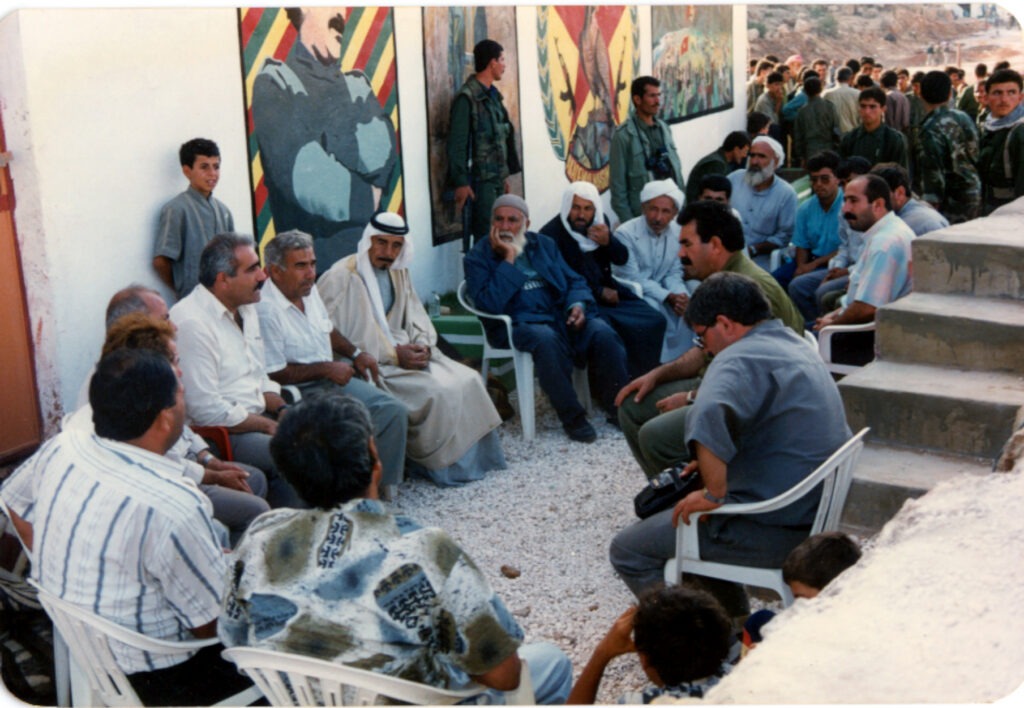
Another obstacle to the US strategy for the Middle East is the perspective of Abdullah Öcalan and the Kurdish freedom movement. In the fourth volume of his Manifesto of Democratic Civilization, published in the early 2000s, Öcalan formulated his counterproposal for Democratic Modernity in the Middle East. In Öcalan’s vision, the diverse and liberal character of the region can best develop in a “Democratic Commune of the Middle East.”
This structure should be characterized by not acting in the interests of a hegemonic center, but rather focusing solely on solving social problems. The problems in Israel/Palestine, Iraq, Kurdistan, or Afghanistan won’t solve with the mentality that caused them in the first place. Since the emergence of nation-states in the Middle East, there have been more genocides, wars, and human rights violations than at any other time in history. That is why actors, committed to solve the crisis of the Middle East, must overcome the mentality of the nation state.
Very few ideas in the Middle East managed to maintain their opposition to capitalist modernity and neither come to terms with it nor dissolve in it. In this sense, Öcalan describes the significance of the “Democratic Commune of the Middle East” as follows:
“The damage caused by problematic mentalities in approaching political and social problems throughout the region over the last two hundred years is instructive enough. It has become abundantly clear that both secularists and religious fundamentalists are not developing solutions, but rather deepening the hopelessness.[…] No matter how many different communities or communes there are, there is room for them within the framework of the main commune or confederation. [Öcalan is not talking here about a state-based confederalism, but a grassroots democratic confederalism]. Given this approach, it is easy to understand how flawed and exclusionary the nation-state is. It is important to know how to run without stumbling over the obstacles of the nation-state, which is supposedly so concerned with independence […]”7
Öcalan’s proposed strategy for the Middle East does not only exist in theory. His ideas connect to a movement and we can observe their implementation in North and East Syria. He himself plays an active leadership role and is the recognized political representative of the Kurdish Freedom Movement in the current “Process for Peace and a Democratic Society” – even though he in the prison of Imrali for over 26 years. Objectively speaking, apart from Öcalan and the Kurdish freedom movement, there is probably no other revolutionary-democratic force in the Middle East that could prevent the cruel plans of Israel and the US. That is why defending the revolution in Kurdistan is a task for all those who want to effectively oppose the US’s efforts described above.
Because today it is more obvious than ever: the interests of the state are not the interests of the people. Local ideas oppose capitalist-liberal and egocentric ideas. All over the world, local communities, the communal spirit, in short, the good in people, are fighting against the state, against exploitation and oppression. In this way, a clear perspective for solving the social problems in the Middle East is able to develop.
For when evil is clearly defined, it is easier to understand what needs to be done. Under no circumstances can we then fall prey to illusions that make us take sides with the institutions of capitalist modernity. No state, no group based on misanthropic ideologies can be a source of solutions. Instead, we must build a third way ourselves: the way of societies, the way of democratic modernity. Neither the imperialist-hegemonic policies of global superpowers nor the classic model of the Middle Eastern nation-state, whether secular or religious, have an interest in resolving the crisis in the Middle East. All these actors act according to their own interests. Abdullah Öcalan’s third way therefore takes the interests of society as its basis and, from there, begins to develop a perspective for solving the socio-political problems of the Middle East.
FOOTNOTES
- https://www.visionofhumanity.org/highest-number-of-countries-engaged-in-conflict-since-world-war-ii/ ↩︎
- https://www.whitehouse.gov/wp-content/uploads/2025/12/2025-National-Security-Strategy.pdf ↩︎
- https://democraticmodernity.com/the-theory-of-democratic-modernity-as-a-guide-for-building-a-new-internationalism/ ↩︎
- https://www.defenseone.com/policy/2025/12/make-europe-great-again-and-more-longer-version-national-security-strategy/410038/ ↩︎
- The “axis of resistance” is a term used to describe a number of Islamic militias close to the Iranian government, such as the Houthis. ↩︎
- At the end of 2024, militias belonging to Hay’at Tahrir al-Sham, an organization that emerged out of the Syrian branch of al-Qaeda (Jabha al-Nusra Front), staged a coup in Syria against President Bashar al-Assad. Numerous massacres and executions since then are evidence of the Islamist policies of the HTS transitional government, whose president is Abu Mohammad al-Jolani. ↩︎
- The book is yet not available in English. We cited from the Germ version: Abdullah Öcalan “DIE DEMOKRATISCHE ZIVILISATION Wege aus der Zivilisationskrise im Nahen Osten”, p.362 ↩︎