
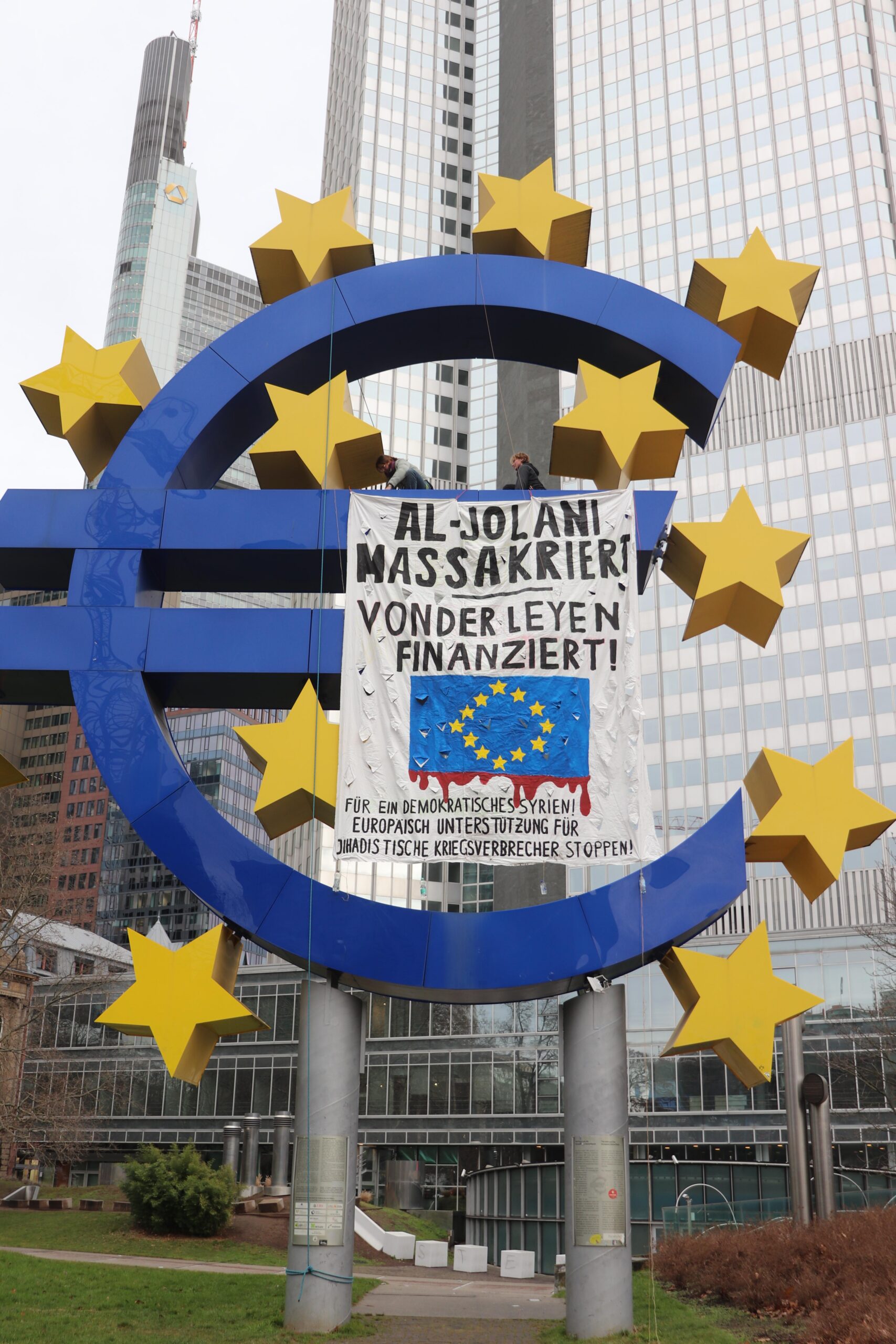
Several days have passed since the fighting in Aleppo. It is easy to prove that global forces were behind the attacks in Aleppo. Gangs classified as international terrorists were involved in the attacks, in which dozens of civilians were killed and at least 120,000 people were forced to flee.
All four commanders of the Syrian Arab Army’s 4th Army Division from Aleppo who led the attack on the neighborhoods are or were part of the Syrian National Army (SNA), a Turkish proxy militia in Syria. Some of them, such as Sayf Abu Bakr, Brigadier General of the 76th Division in Aleppo, are on the EU sanctions list for the massacres of Alawites in the spring of last year.
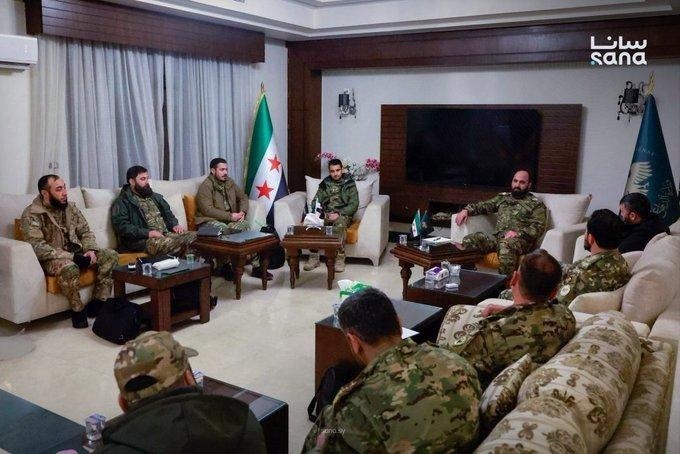
In recent days, the Syrian Arabic National Agency (SANA) has been showing images of massive troop movements from eastern Syria to regions west of the Euphrates, about 60-70 kilometers from Aleppo. The troop concentrations and military clashes between the Syrian Democratic Forces (SDF) and the Syrian army are already taking place in the regions around Deir Hafer, Maski, Al-Hafsah, Sebhat al-Jabbul, Tabqa, and around the Tishreen Dam. Yesterday, January 14, 2026, the post office and bakery in Deir Hafer were completely destroyed by drone strikes. Today, January 15, 2026, HTS called on the population to evacuate the region around Deir Hafer and head for Aleppo via the main road.

Since mid-2025, both the Turkish state and some Arab media outlets, such as the Syrian Arab News Agency (SANA), have been deliberately attempting to incite the Arab population against the Kurdish population in order to prevent further negotiations between the government and the Democratic Self-Administration of North and East Syria (DAANES). Now, all signs point to war. A democratic solution seems a long way off for the time being. The revolution in North and East Syria is under greater threat than it has been for years.
Who is HTS, who supports them, and why?
Haya’at Tahrir al Sham (HTS) is an organization that emerged from the al-Nusra Front. The al-Nusra Front is the Syrian branch of al-Qaeda, one of the most notorious and brutal Islamist terrorist organizations in the world.
Baghdadi himself, the man who led the so-called Islamic State, sent Jolani to Syria to establish the al-Nusra Front there. In 2017, after several disputes between Jolani and Baghdadi, Jolani founded HTS. Among other things, he attempted to cleanse himself of his Islamist history. This is how he began his journey into international politics.
In the Syrian province of Idlib, in the northwest of the country, HTS established a “Syrian Liberation Government” (SG) in 2017, which was to become the social arm of the newly repainted jihadists. England, the US, Saudi Arabia, Qatar, and Turkey had been supporting opposition groups in Syria since 2011 in order to overthrow the regime of Bashar al-Assad. Why? Bashar al-Assad was primarily under Russian and Iranian influence. His overthrow was one of the goals of the reorganization of the Middle East. On the one hand, new and more efficient trade routes, led by the US, were planned. The US, but also other beneficiaries of the new projects, saw Russian influence in Syria as a potential security risk. On the other hand, support for the coup was intended to cut off Hezbollah’s logistics route through Syria.
Terrorism on the international stage
After HTS took power in Syria, it was showered with congratulations by the international community. The UN Security Council, the US, and the UK, along with other organizations and governments, had classified HTS as a terrorist organization. Today, all of the above have lifted this classification, despite the organization’s documented human rights violations and war crimes, including those committed last year.
The situation in Syria remains unstable. A multitude of groups, organizations, and armed militias are just waiting for the opportunity to seize power from the fragile transitional government. Attacks such as those in Aleppo are grist to the mill in an already unstable region. And international forces are also wrestling even more intensely for influence in Syria in crisis situations.
Turkey: Foreign policy of total war
Starting with Turkey, we want to explain the role that the interests of international governments play in the conflict. Ayşegül Doğan, spokesperson for the DEM Party, had already criticized the government in Ankara in July for its destabilizing foreign policy and proposed an “alliance of peace” between Syria, Iraq, the autonomous region in South Kurdistan, and Turkey. However, the efforts of some parts of the government in Ankara last year went in a different direction.
Instead of playing a mediating and peacemaking role, Hakan Fidan, the Turkish foreign minister, in particular, used his influence in Syria to torpedo negotiations between Damascus and the self-administration. Several sources say that the foreign minister of the transitional government, al-Shaibani, in particular, is in close contact with Fidan. The line that Fidan represents within the Turkish state is the line of war. “The SDF will only change its position if it is confronted with force,” he said in an interview. This language only escalates and exacerbates the contradictions between the transitional government and the DAANES.
After the HTS coup in Syria at the end of 2024, the Turkish state supported the government in Damascus by training soldiers and supplying weapons. The statement by Turkish Defense Minister Yaşar Güler that “Turkey would rush to Syria’s aid if desired” is not a declaration of brotherly solidarity, but only reinforces the suspicion that parts of the Turkish government are actively seeking to bring about an escalation in Syria.
It is a lesson we can learn from history that insisting on the total annihilation of the Kurdish people obviously could not achieve a solution to the Kurdish question. On the contrary, even Turkey, which wanted to establish itself as the hegemon in the region through its anti-Kurdish policy, is now confronted with deep economic and social problems.
However, according to the latest information, Turkey is not only an outside provocateur, but also a party to an impending war. According to recent reports by the “Strategic Research Center of Kurdistan” (NLSK), Turkey has already sent over 2,000 gang members to Girê Spî, a region in northern Syria occupied by Turkey since 2019. According to them, the goal of deploying these Islamist gangs is to weaken the SDF forces with short-term attacks from the north, while the main attack will focus on the regions of Deir Hafr and Meskene.
The complicity of the EU, the US, and Israel
The US is publicly advocating de-escalation in response to the current attacks. However, it remains to be seen whether its interest in ending this conflict quickly is strong enough to de-escalate it through diplomatic means. There is no question that a fragile government such as HTS would never launch such a large-scale attack without the approval of the US and Israel. This is because the US wants to put the DAANES in a negotiating position where surrender is their only option. It could therefore be in their interest to quickly resolve the conflict in Syria in order to overthrow the government in Iran as soon as possible. Whether the conflict is resolved militarily or politically seems to be primarily a question of time for them.
The HTS receives financial support from various sources. The European Union stands out with its announcement on January 9 of 620 million of euros in support for the transitional government. Its primary interest is likely to stabilize Syria to such an extent that massive waves of deportations to Syria, especially from Germany, become possible. This could be a strategy to gain political ground, particularly against the emerging nationalist parties. In addition, the EU’s motivation is probably to limit Russian and Iranian influence. A new government could allow Russia to rebuild lost military bases. The EU may also fear a renewed rapprochement with Iran and its “axis of resistance.”
But this is precisely why the European Union, in particular, should work to prevent a war in Syria. The troops that HTS has withdrawn from unstable areas such as Latakia and sent to the regions west of the Euphrates will give other armed groups room to launch uprisings and perhaps even coup attempts. Not only the Druze and Alawite populations, but also hardliners from the so-called Islamic State are in conflict with the government in Damascus. An attack on the DAANES carries serious risks that could lead to a new civil war. This would be neither in the interest of the EU nor in the interest of the peoples of the region.
One of these risks is the resurgence of the so-called Islamic State (IS): Already today, January 15, sleeper cells of the so-called Islamic State are attempting to exploit the situation and are launching attacks on prisons and IS prisoner camps in order to mobilize their fighters for the planned massacres. The SDF has stated that it is prepared to repel any attacks.
Only a matter of hours: The attack is imminent
But war seems only a few hours away. The NLSK refers to leaked documents that reveal the attack plan of the transitional government and Turkey. After the first attack by HTS gangs and the Turkish state in Deir Hafr and Meskene, the transitional government is reportedly planning a second attack on Raqqa and Deir Zor with former IS fighters. Turkish drone attacks on the region in recent days indicate that this plan was developed directly by the Turkish intelligence service MIT.
The leader of the HTS militias, Ahmed al Sharaa, has openly stated in an interview what his government is really after in the attack: namely, oil, gas, agriculture, water, and the energy sources of northern and eastern Syria.
The war propaganda machine of the HTS and the Turkish state is already running at full speed. Fear, uncertainty, and division are the main targets of their black propaganda. Ahmed al-Sharaa is currently attempting to deliberately detach the Kurdish population from the Democratic Self-Administration of North and East Syria by actively strengthening nationalist thinking and movements. His goal is to pacify the Kurdish population through cultural rights and break their struggle for a free, multi-ethnic, and democratic Syria.
The resistance will prevail!
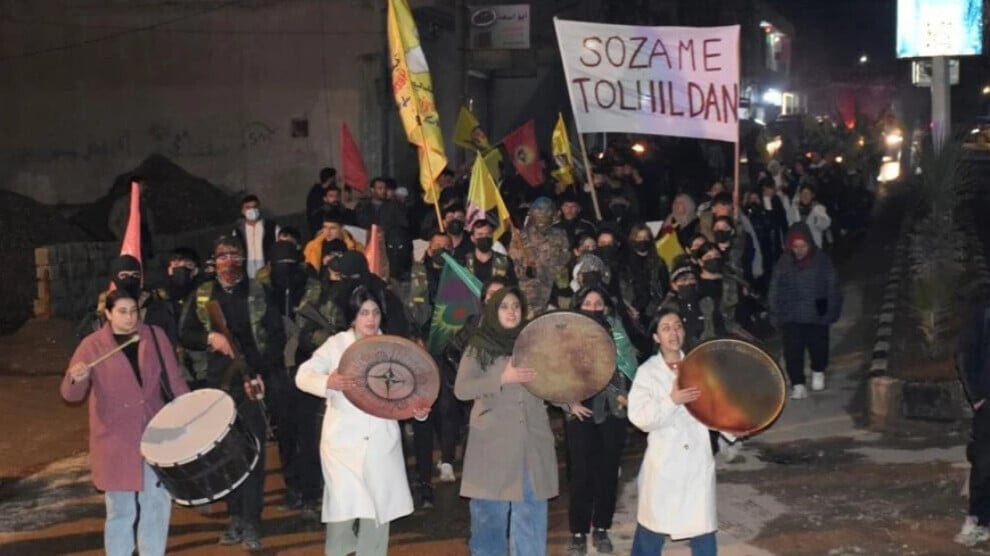
But the Kurdish population has already proven in recent days that it stands behind the DAANES. The resistance against IS in Kobane and the reality of the war of the last 10 years in Kurdistan have proven that Kurdish society can repel even the strongest military opponents through its resistance.
The path of negotiations may have failed for now. But the defense of the revolution, and the belief in victory, the hope that good can and will prevail, should now become the basis of our resistance: Together on one front, together with our comrades in Rojava, we will defeat the Islamist gangs and their international accomplices!