
Giulia Prati
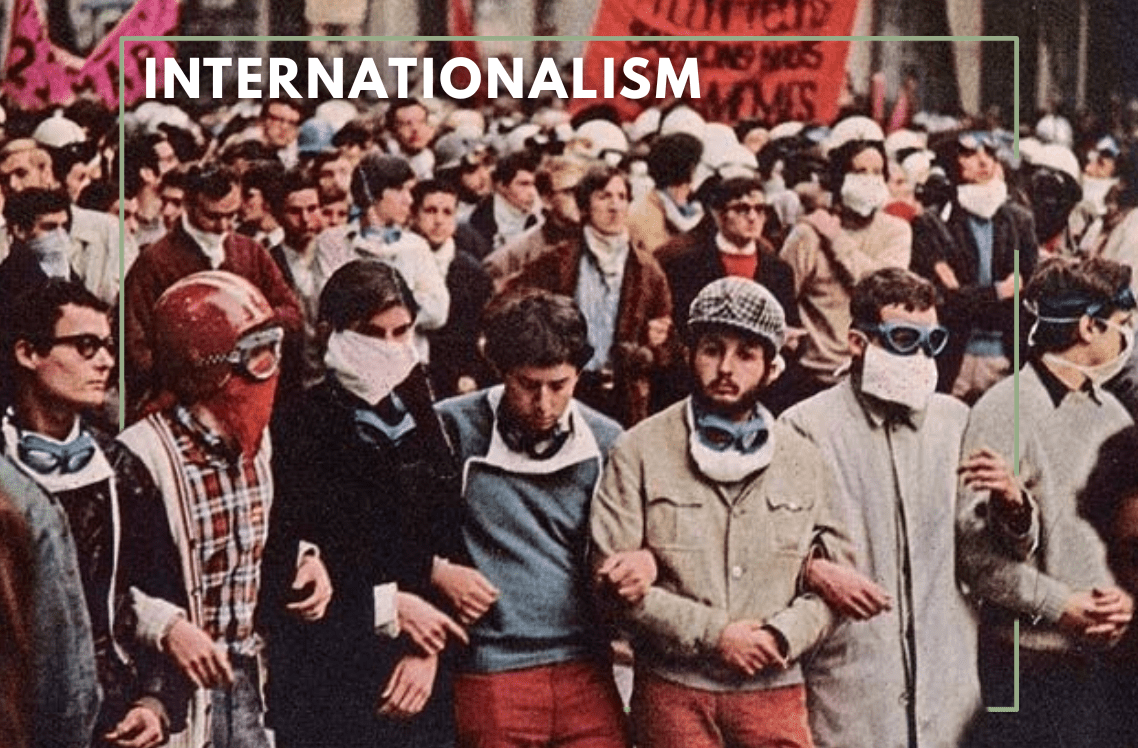
“Always be capable of feeling deeply any injustice committed against anyone, anywhere in the world. This is the most beautiful quality in a revolutionary”1. Che Guevara wrote these words to his children in a letter he sent to them in 1965. He had decided to leave Cuba to continue the revolutionary struggle wherever it was needed — first in Congo, then in Bolivia. With just these few words one can grasp the meaning of internationalism.
Internationalism means consciously feeling that one’s own freedom is connected to the freedom of all others, just as one’s own oppression is. It is the struggle for a sense of unity where the capitalist and patriarchal system divides. It is also the feeling of the historical depth of the resistance that peoples and societies have waged beyond national borders, fighting for dignity, freedom, and equality wherever these were threatened.
This historical consciousness and this sense of connection are sources of hope and possibility — but they must always be accompanied by a concrete, everyday practice, by a political discourse, and by an organizational proposal. Che Guevara’s words carry deep meaning; they are not abstract, because he put them into practice consistently.
Internationalism is the unity of struggles, belonging to different historical moments and different geographical areas, through a concrete practice.
Historically, the term “internationalism” is connected to the phase of stabilization of capitalism as a system of global domination. In this phase, nation-states began to proliferate as instruments of control over society and peoples. In parallel, the sentiment of nationalism was fueled, and in opposition to it the concept of internationalism emerged. The Internationals were founded in this phase, as a reaction to the need to find a response to the economic, social, and political circumstances of the capitalist system of 200 years ago.
However, the values underlying internationalist practice — unity, solidarity, collective struggle for human dignity — go back much further. Throughout the course of history, there have been struggles capable of uniting different cultures and identities against oppressive, colonialist, and exploitative systems. Internationalism is the legacy of this culture that fights against the capitalist system on a global level.
In the 21st century, humanity is facing problems that are different than those of the past centuries. The “end of history” has been proclaimed especially by the U.S., a new “world order”. And yet, day after day, it becomes increasingly clear that the current system is the greatest disorder in history, full of injustices and based on the destruction of nature and of the social fabric. The capitalist system is in crisis, and it desperately seeks ways out of this crisis, indifferent to nature, to people, to life itself. It is also a system deeply organized on a global scale: the Epstein files case2 was the latest proof of this corrupt and diseased system of transnational connections among the powerful, operating like an untouchable caste.
In this landscape, it is urgent and necessary to rethink internationalism as a response to the conditions of the present time. The capitalist system is not only a force organized militarily, in terms of infrastructure, and technologically on a global level. It is a system based on power and on inequality, that colonizes the minds and hearts of both individuals and whole societies. In this way, and by trying to establish philosophical hegemony, it forces a specific form of materialistic life on people. It builds the conditions so that society suffers from hunger, poverty, and repression. It is therefore necessary to challenge it with a global struggle — an internationalism that is an organized, coordinated, and revolutionary force capable of standing against the dominant global power, not merely to survive, but to win and dismantle the patriarchal, capitalist, and fascist system.
THE FIRST, SECOND AND THIRD INTERNATIONAL
As already mentioned, the emergence of the concept of internationalism is tied to the developments of the 19th century. The industrial revolution and the development of the capitalist system opened up major social and class contradictions. Those, together with the values inherited from the French Revolution of 1789 (namely equality, freedom, and fraternity) led to the eruption of the revolutions of 1830 and 1848. These two revolutions took place in Europe, with a significant impact especially in France. They were directed against the aristocracy and against that bourgeoisie which, in a short time, will reveal its true interests at the expense of the lower classes and the proletariat. These events brought important developments for the socialist thought of the time, in terms of ideology, action, and organization. In this context, Marx and Engels wrote the Communist Manifesto as a political manifesto of the Communist League, an early organization with internationalist aspirations founded in 1847. The aim of Marx and Engels was to provide proper organizational direction to revolutionary movements. The Communist Manifesto was in this sense a fitting response to the needs of the time, guiding political discourse in depth and calling for an international class organization with the famous slogan “Workers of the world, unite!”.
The response to this call was the founding of the International Workingmen’s Association, known as the First International, in 1864 in London. It was already clear that the capitalist system was organizing itself internationally, and for this reason it was necessary for workers to be able to coordinate at the same level, while always remaining active at the local dimension. The First International was able to provide the socialist movement with an organizational structure capable of coordinating, building international solidarity, strengthening and creating organizations. It was ideologically very heterogeneous: it encompassed communist, socialist, anarchist, anti-colonial, and anti-imperialist lines of thought, which often had contradictions among them. Then, from the Paris Commune in 18713, a lot of practical experience was also gained. This intellectual and practical development led, however, to division and factionalism. The contradictions between different thoughts were not overcome; on the contrary, they sharpened, especially between the positions expressed by Marx and Bakunin. The breaking point came with the expulsion of the anarchists from the International. A few years later, in 1876, the First International dissolved.
The process of militarization that the capitalist system started in order to establish its dominance, the threat of a world war, and the weakening and fragmentation of socialist forces made it necessary to re-evaluate the organization of the workers’ movement on an international scale. As a result, the Second International was founded in 1889. The Second International was built in clear accordance with the Marxist line. It rested on a conviction that arose in Marx following the experience of the Paris Commune: the working class must organize itself into political parties. Socialist and social-democratic parties proliferated across Europe, and the Second International developed more as a gathering of representatives of parties from different countries. The goal was to create a common understanding and a common plan of action against the possibility of war, building a shared discourse around antimilitarism. It was, however, on the approach to war that the deepest contradictions emerged. On one side, a social-chauvinist approach that insisted on supporting national bourgeoisies during the war began to develop and was supported by the majority within the social-democratic parties. On the other, the idea of fighting against national bourgeoisies and transforming the imperialist war into a civil war, advanced above all by the Bolsheviks in Russia. The minority positions within the social-democratic parties generated in most countries a strong front of opposition to the war, as it happened in Germany with the Spartacus League. It was therefore on the basis of this contradiction that the Second International fractured.
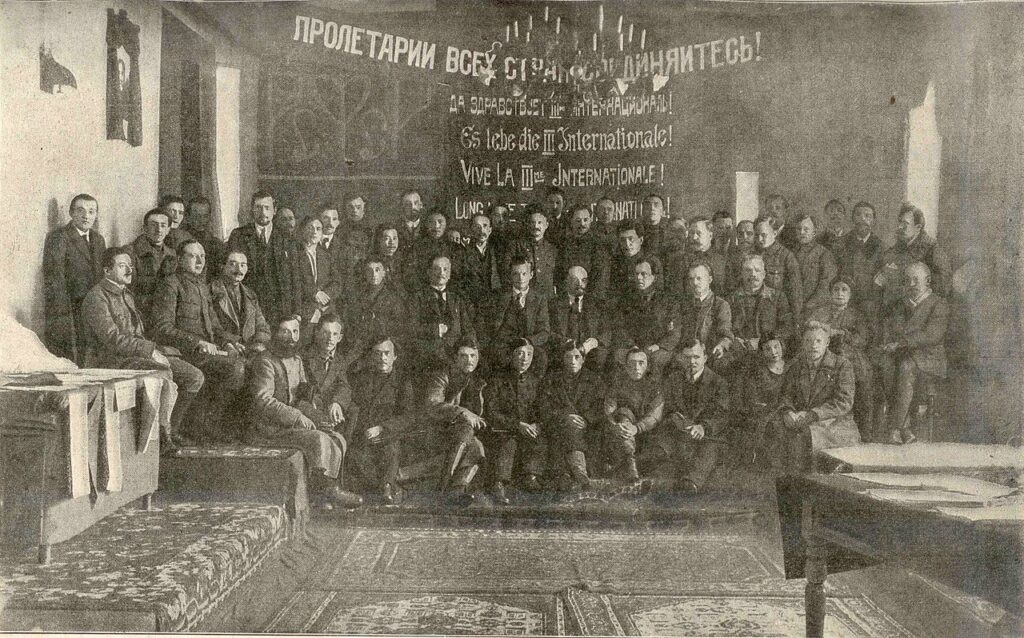
The Russian Revolution of October 1917 has been a major and historic success for the line advanced by the Bolsheviks, as well as for the entire history of socialism. As a result of this success, and because of the internal contradictions within the Second International, the Third International was founded in Moscow in 1919. It is also known as the Comintern, or Communist International. At the foundation of this organization was the need to build Communist Parties in every country, and the Comintern was seen as the superior organization encompassing all the Communist Parties of the world. The goal of the Third International was to prepare and carry out the World Communist Revolution, to be achieved by spreading the Russian Revolution across the globe. This objective was at the heart of discussions that animated the second half of the International’s existence: is it possible to carry out the struggle for socialism in the same way in every country? Or should it be adapted to the different national realities? In the background of these debates lay the difficulties of the outbreak of the Second World War.
A key element in the history of the Comintern is the Conference of Baku of 19204, centered primarily on the theme of colonialism, which challenged the Eurocentric view that had characterized the First and Second Internationals. The Comintern was able to concentrate its efforts beyond Europe, supporting anti-colonial and anti-imperialist revolutionary and organizational processes in Asia, Africa, and other territories that at the time were colonized. The Comintern was dissolved during the turmoil of the Second World War, in 1943.
What stands out when retracing this history is the fact that with the passage from one International to the next, ideological variety diminished. This was certainly a historical and momentary response to internal conflicts that could not be resolved. The First International became stuck on the conflict between Marx and Bakunin, and the anarchists no longer participated in the Second International; between social-democrats and communists, no common ground was found capable of effectively opposing the First World War, and the Comintern was then joined only by Communist Parties. Over time, political practice has become less varied.
At this point, it is necessary to recognize and avoid the risks of two attitudes toward the history of the Internationals. On one hand, one must avoid thinking that what is needed is simply to add another step in the same direction indicated by the efforts of the 19th and 20th century. On the other hand, however, one must also avoid thinking that a complete break from history is possible. The Internationals left a rich legacy of thoughts, errors, and lessons to be learned. Towards this legacy, an active role is required — to evaluate, to criticise, to distinguish successes from failures. A new International must hold onto historical consciousness, use it as a compass, while being capable of adapting it to a deep analysis of the needs and conditions of the present.
WHAT GLOBAL CHALLENGES AND CIRCUMSTANCES EXIST TODAY?
The conditions in which democratic forces find themselves today are profoundly different from those faced by the organizations of the First, Second, and Third Internationals.
The first two World Wars reshaped the balance of the world, and from the end of the Second World War onward the globe was divided into two blocs: on one side the capitalist bloc led by the leadership of the U.S., and on the other the communist bloc led by the USSR. The clash of these two poles fueled the Cold War for more than 40 years. The name “Cold War” indicates the fact that no direct confrontation took place between the U.S. and the Soviet Union. The Cold War was an ideological, economic, technological, and scientific war, with the goal for each pole of securing its influence over the entire globe.
With the fall of the Berlin Wall in 1989 and the subsequent collapse of the USSR in 1991, the supposed “end of history” was reached. Neoliberalism, uncontrolled nationalism, the emergence of far-right forces: all of this has been (and continues to be) an attack on socialism, led by the capitalist bloc that came out victorious from the Cold War. With the decline of real socialism in the 1990s, capitalist hegemony took root and a new system of war emerged — the Third World War5. The U.S. believed it could easily impose itself as the sole global hegemon. The scenario that developed instead was not a world guided by a single pole, but a multipolar system of different hegemonic powers all seeking to acquire as much power as possible. In short, a hegemonic war among many hegemonic forces.
During the Cold War, the goal was the mutual liquidation of the two poles. In the Third World War, this is not always the case. Often, the goal of hegemonic forces is not to destroy one another, but to make the enemy weaker and more dependent on oneself. Like a pyramid, each force seeks to step over those blocking its way up, pressing them down in order to reach the peak of hegemony and power. The forces at play in the Third World War are not defined by paradigmatic differences, and when they show ideological differences, these always represent different faces of the same coin — none of them offers a real solution to social problems. It is a conflict between forces that compose and sustain the same system of capitalist modernity. It is a conflict necessary for keeping this system standing.
In the time of the three Internationals, as already noted, capitalism was flourishing. The process of industrialization and its impact on working conditions directly affected workers. On the basis of this context political discourse and organization focused on the working class. Today, capitalism is collapsing6. The Third World War is an inherent attack on society, and is carried out with an organization and with weapons that operate on a global level. Femicides and the commodification of women, the destruction of nature and ecological catastrophes, the fragmentation of the social fabric, the intellectual death caused by a wrong use of social media and AI, violence, and the absence of ethics. An ideological attack it’s being carried out aimed at robbing people of their morality, their hope, and their capacity to imagine different possibilities for life. Every people, at every latitude, suffers the consequences of these attacks, even if in different forms. In this sense, a unity that goes beyond class alone is necessary. Women’s struggles, communal values, collective and popular resistances against colonialism and capitalism: a new internationalism must build unity among all of these experiences on a common anti-system foundation.
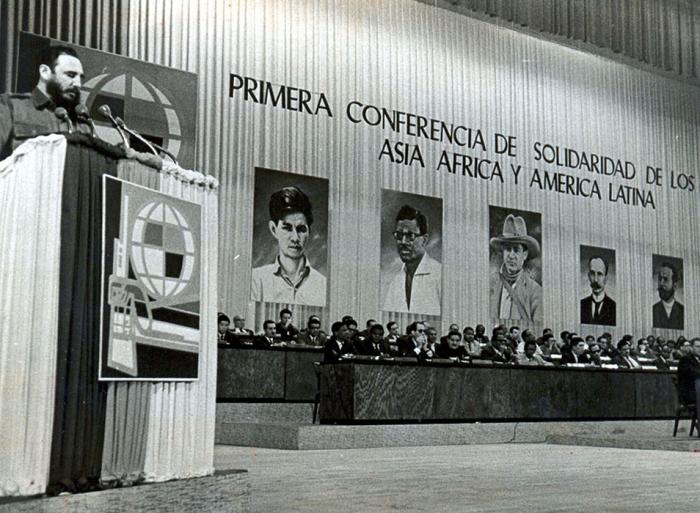
The different conditions between the present and the time of the three Internationals concern not only the system of war, but also the new experience of internationalist struggle that has accumulated over the past century. In particular, anti-colonial internationalism after the Second World War developed and achieved important results. To cite just one example, in 1966 the Tricontinental Conference7 took place in Havana. It was the first platform capable of bringing together delegates from the three continents of Latin America, Africa and Asia on the basis of a revolutionary perspective of liberation struggle, against colonialism and U.S.-american imperialism. The Tricontinental was strongly influenced by the Cuban Revolution and the national liberation struggle of Vietnam. Many other examples could and should be cited and explored: from the Spanish Civil War, to the national liberation movements and the youth revolts of ’68, to the No Global movement, the Levamiento Zapatista, and the revolution in Rojava. There has been continuity and richness in the experiences of internationalist struggles. Many of the limits present in the past, such as eurocentrism and the exclusion of women, were criticized and there was an active struggle against them. The steps taken from here onward are sustained by the effort and commitment of so many peoples who have fought, and can resound to the rhythm of “create two, three, many Vietnams!”8
PERSPECTIVES FOR A NEW INTERNATIONALISM
In recent decades, intellectual and political discourse has progressed and deepened. Important advances have been made in terms of creating socialist solutions that can serve as concrete alternatives to capitalism in its current phase. The errors of anti-system forces that led to the collapse of the USSR and to the current global condition have been identified and analyzed. Moreover, a great deal of experience in internationalist struggle has been accumulated.
On the other side, the system of capitalist modernity has deepened the chaos and represents a threat to the very continuation of human existence. The existence of nature as a space in which social life can flourish is at serious risk. What is needed in the face of all this is an antidote — a force capable of fighting for a different paradigm. What is needed is a refusal of the pyramid; not an attempt to climb it in order to change it. It is necessary to embark on a serious search for a new system that can overcome capitalism and offer an alternative to it. The attacks that the current system carries out are global and hegemonic: it is therefore natural that the response should be based on an idea of world revolution. A world revolution that envisions a global structure and whose fundamental principles are international solidarity and political unity.
A new International must be able to grasp the legacy of history, adapt itself to the present, and take on the responsibility of overcoming the mistakes of the past. In this sense, an approach focused solely on the question of class must be overcome. What must animate a new International is a radical struggle against social sexism, and women must take on a fundamental role within it. The role that women have built and assumed in the struggles of the 20th century has been revolutionary, and the analyses developed in recent decades on the gender contradiction as the seed of the system of power and domination cannot be ignored. It is therefore imperative to fight in a unified and collective manner against the patriarchal system. Without this foundation, no alternative to capitalism can be developed, and no democratic change can occur.
It is also undeniable that the earth stands on the brink of collapse. For this reason, the ecological question — along with all the movements and realities fighting with this focus — must be included. Finding an alternative to the current system and rejecting industrialism by developing an ecological approach to industry are long-term strategies for building peace and, by now, a matter of survival.
An essential step is to break with a eurocentric vision, learning from the lessons of the Third International and anti-colonial internationalism. What is needed is an internationalism capable of overcoming the opposition between East and West and developing their dialectic. The problems produced by the Third World War are problems of humanity, and as such they must be confronted. The differences in how they are experienced in different places must be recognized — not denied — but these differences must not be allowed to become a reason for separation. The game of nationalisms is to put different peoples against one another, distracting from the true common enemy. Only through an alliance of all peoples will it be possible to create a front of resistance adequate to the problems of today.
In the current scenario of the Third World War, the strategy that nation-states are pursuing with increasing explicitness is that of rearmament and physical and ideological militarization. One task from which a new International cannot step back is the development of a common discourse on antimilitarism — one capable of addressing central questions such as the development of common strategies for opposing and surviving war as democratic organizations and forces.
Today, the way out of the global crisis requires global action. To rise to the challenges of the present, and above all as an imperative for success, what is needed for a new International is a broad alliance, one that wants to hold together diverse thoughts, ideologies, paradigms and opinions. A new International today must have the courage to broaden the spectrum of viewpoints within itself. It is necessary to bring together all currents of thought that see the capitalist system as an enemy to be opposed, and that are building an alternative to it. This must not be limited to explicitly political organizations, but must also open up to cultural, ecological, social, feminist movements and peoples. A political unity capable of avoiding separation and focusing instead on a shared and common political objective. After all, internationalism does not simply mean having a global outlook; it represents unity in diversity. A unity in diversity that is forged though efforts and sacrifices, not merely in words. Differences should not be a source of division, but should rather create the broadest possible basis for a shared struggle against a common enemy. Such a political unity must be grounded in a political program built around anti-capitalism, anti-fascism, and anti-sexism.
To make all of this possible, free and open discussion, the exchange of ideas, and the confrontation between different opinions must be encouraged. A suitable environment must be created so that such discussions can take place. One of the main problems that led to the failure of the three Internationals must be addressed: the inability of anti-system forces to develop a constructive way of discussing ideological contradictions — a democratic culture of debate. These discussions must then be made strong by a common practice — an offensive against the system of violence and oppression that is generating the greatest chaos in the history of humanity.
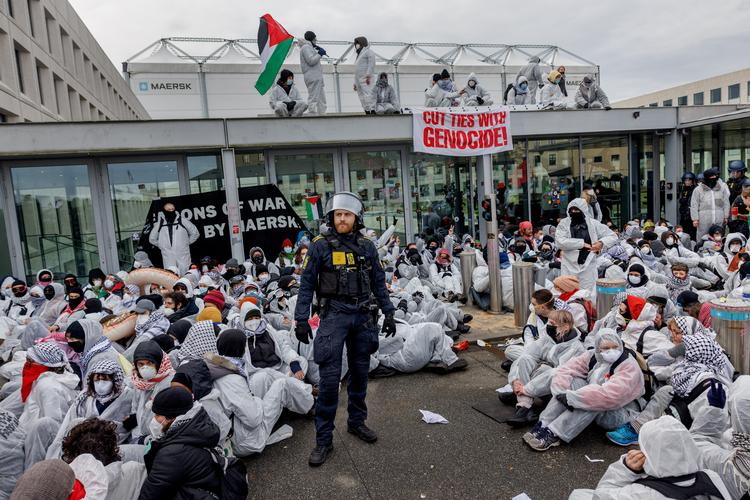
In recent years, the so-called ‘Generation Z’ has taken to the streets its opposition to the current system in a clear and decisive manner. These have often been protests born out of specific issues, but all of them then took on an anti-governmental character. This was seen in Bangladesh, where a protest against the public employment system led to the resignation of the Prime Minister. It was also seen in Kenya, where an unacceptable finance bill led to uprisings against corruption, femicides and state repression. In Madagascar, young people took to the streets against the lack of water and electricity, and after a month of protests the president was forced to leave the country. From the mobilizations and university occupations for Palestine, to the Gilet Jeunes in France, to the revolution in Rojava and the Springs of the peoples. There are countless examples of recent and ongoing popular movements contesting capitalist modernity. And yet, they too often remain confined to a local or national scale. If they operated within coordinated platforms, they would amplify their reach and impact.
Youth, women, workers, oppressed peoples, groups defending the land, dreamers of a utopia of dignified, beautiful, and free life: now is the moment to unite around a common political objective, to recognize one another in each other’s differences, and — strengthened by them — to rise together and win.
- Ernesto “Che” Guevara, Letters. Personal and political, 1947-1967, Penguin Canada, 2022 ↩︎
- Jeffrey Epstein is an American financier. The Epstein files are a collection of millions of documents, images and videos that contain evidence of sex traffic and other illegal activities conducted by Jeffrey Epstein. They are only partially released, but even in the ones that were published until now connections with countless public and political figures emerged. The connections are not only within the U.S., but spread all over the world. ↩︎
- The Paris Commune has been a self-proclaimed and self-organized government in the city of Paris. It lasted from the 18th of March until the 28th of May, 1871. It was lead mostly by anarchists, communists, socialists and republicans. It is considered by Marx the first example of “dictatorship of the proletariat”. ↩︎
- The Conference of Baku is also known as the Conference of the Peoples of the East. It was held between the 1st and the 8th of September, 1920 in Baku, Azerbaijan. It hosted more than 2000 delegates from Asia and Europe. It addressed topics as anti-colonialism and anti-imperialism. ↩︎
- https://www.ronahi.eu/2026/from-iran-to-the-world-the-third-world-war-unfolding-before-our-eyes/ ↩︎
- https://democraticmodernity.com/battle-of-ideas-internationalist-resistance-against-the-empire-of-chaos/ ↩︎
- https://www.revistalegerin.com/post/create-two-three-many-vietnams-the-first-tricontinental-conference-of-1966 ↩︎
- https://www.marxists.org/archive/guevara/1967/04/16.htm ↩︎